
Our projects

Commercial VRF system

Discover the VRF system replacement at the Ibis Grand-Place hotel: Mitsubishi Electric two-pipe energy renovation completed by Hecker & Frères Énergie (HFE) in Lille.

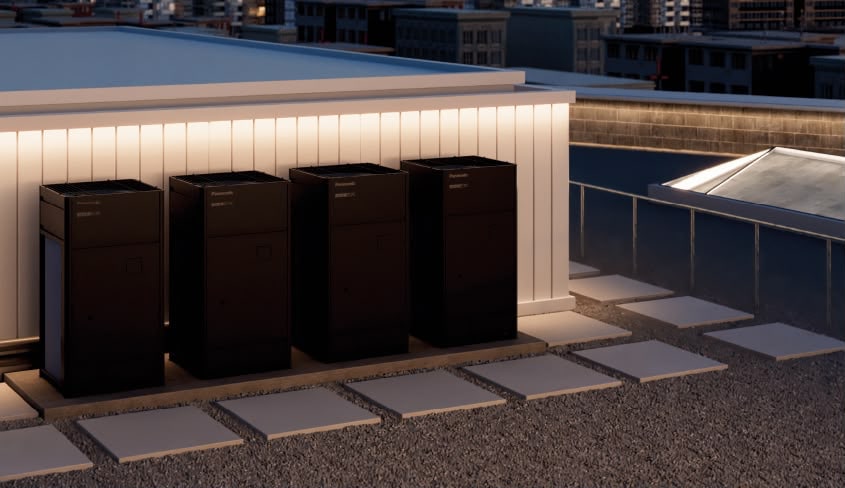
Panasonic ECOi EX outdoor VRF units installed on a commercial rooftop terrace

What is a commercial VRF system?

Installing a VRF system improves thermal comfort while reducing energy consumption. The solution adapts to the needs of each zone, provides precise temperature control and ensures quiet operation.

VRF is particularly suited to offices, retail premises, hotels and large floor areas. One or several outdoor units supply multiple indoor units (wall-mounted, cassette, ducted), each independently controlled.

Benefits of VRF in commercial buildings

  • Independent control of each zone or room.
  • Automatic output adjustment to actual demand.
  • Lower consumption compared with fixed-output systems.
  • Quiet operation, suited to professional premises.
  • Reversible solution: cooling and supplementary heating.
  • Ideal for offices, shops, hotels and large commercial spaces.
1 Project 1

VRF system replacement at the Ibis Grand-Place hotel

Mitsubishi Electric two-pipe VRF energy renovation — 69 indoor units, 6 rooftop groups

The project in figures

69

Indoor units

6

Rooftop VRF groups

2-pipe

VRF configuration

20-40%

Energy savings

The installation in pictures

Servicing a Mitsubishi Electric City Multi VRF group on the roof

The result

  • Modernisation

    Full replacement of ageing VRF equipment with a new Mitsubishi generation.

  • Hotel comfort

    Precise room-by-room control for guest comfort.

  • Energy savings

    Lower consumption thanks to inverter technology and power modulation.

  • Supervision

    Centralised management, alarms and visibility for technical teams.

About this installation

Project overview

As part of modernising the heating and air conditioning systems at the Ibis Grand Place hotel, a major energy renovation project was carried out to replace the ageing variable refrigerant flow (VRF) systems.

  • 69 indoor units distributed across guest rooms, corridors and common areas
  • 6 VRF groups on the roof
  • Unit capacities from 6 kW to 25 kW depending on the zones served
  • Technology that had become less energy-efficient and more costly to maintain

The project aimed to improve energy performance, reduce electricity consumption, increase system reliability, ensure occupant comfort and modernise regulation and supervision.

Solution implemented

The existing installation was replaced with a new generation of Mitsubishi Electric VRF systems using PUHY / PUHZ / PUHD outdoor units according to the capacities and configurations required.

The system was kept in a two-pipe configuration, particularly suited to hotel operation.

  • Latest-generation inverter technology
  • High-efficiency compressors
  • Optimised heat exchangers
  • Better partial-load management
  • More precise control

How the two-pipe system works

The two-pipe VRF system uses a liquid line and a gas line. The amount of refrigerant is continuously adjusted by the outdoor units according to the actual needs of guest rooms and common areas.

Each indoor unit can modulate its output independently to maintain the desired temperature precisely.

  • Excellent responsiveness
  • Greater comfort for guests
  • Lower consumption
  • Fewer start/stop cycles
  • Continuous adaptation to actual hotel occupancy

Indoor unit replacement

All 69 indoor units were replaced or reconnected depending on their condition and compatibility with the new equipment.

  • Improved acoustic comfort
  • Better room-by-room control
  • New remote controls installed
  • Improved air distribution quality

Each room now benefits from more precise temperature control.

Roof works

The six rooftop VRF groups were removed and replaced with new Mitsubishi units.

  • Roof safety measures
  • Lifting operations
  • Adaptation of existing supports
  • Refrigerant connections
  • Electrical connections
  • Communication network connections

The new units deliver better seasonal efficiency while maintaining low noise levels.

Refrigerant network

The entire refrigerant network was inspected, adapted or replaced as required.

  • Leak testing
  • Replacement of defective sections
  • Refrigeration brazing rework
  • Nitrogen pressure test
  • Deep vacuum pull
  • Vacuum hold test
  • Adaptation of manifolds and distributors

Particular attention was paid to connection quality to ensure long system life.

Control and supervision

The installation now benefits from modern control providing:

  • Centralised management: control of all 69 indoor units, time scheduling, setpoint and heating/cooling mode management
  • Energy optimisation: automatic adjustment of compressor frequencies, delivered capacity and each zone's requirements
  • Alarm management: monitoring of refrigerant pressures, temperatures, communication faults and operating anomalies

Technical teams now have better visibility over system operation.

Commissioning

Commissioning was carried out in accordance with manufacturer procedures.

  • Refrigeration checks: nitrogen test, leak test, vacuum pull, charge top-up, superheat and subcooling verification
  • Electrical checks: supplies, protection devices, BUS communications, absorbed currents
  • Setup: automatic addressing, control programming, zone configuration, functional tests
  • Final validation: heating and cooling tests, temperature checks, operating readings, commissioning file handover

Energy performance

The old system featured older technology, less efficient compressors, degraded seasonal efficiency and high partial-load consumption.

The new Mitsubishi generation generally delivers lower electricity consumption, improved seasonal efficiency, better mid-season capacity recovery and optimised room-by-room operation.

In hotels, where occupancy varies significantly throughout the day and year, gains are particularly noticeable thanks to continuous power modulation.

Depending on the condition and age of the replaced installation, savings on this type of renovation are generally between 20% and 40% of heating and cooling consumption.

Benefits achieved

  • Full modernisation of equipment
  • Improved guest comfort
  • Better temperature control
  • Lower electricity consumption
  • Reduced maintenance costs
  • Greater operational reliability
  • Centralised system management
  • Extended system service life

Conclusion

Replacing the 6 rooftop VRF systems supplying 69 indoor units at the Ibis Grand Place hotel with a new generation of Mitsubishi Electric two-pipe systems has fully modernised the building's HVAC installation.

Thanks to latest-generation inverter technology, high-performance centralised control and full commissioning including all refrigeration and electrical checks, the hotel now has a more reliable, more economical and more comfortable system for its occupants, while significantly reducing operating costs and energy footprint.

Mitsubishi Electric

Mitsubishi Electric manufacturer warranty

3-year parts warranty

Free quote

Planning a VRF system for your premises?

Free survey, quote within 72 hours, support by HFE.